
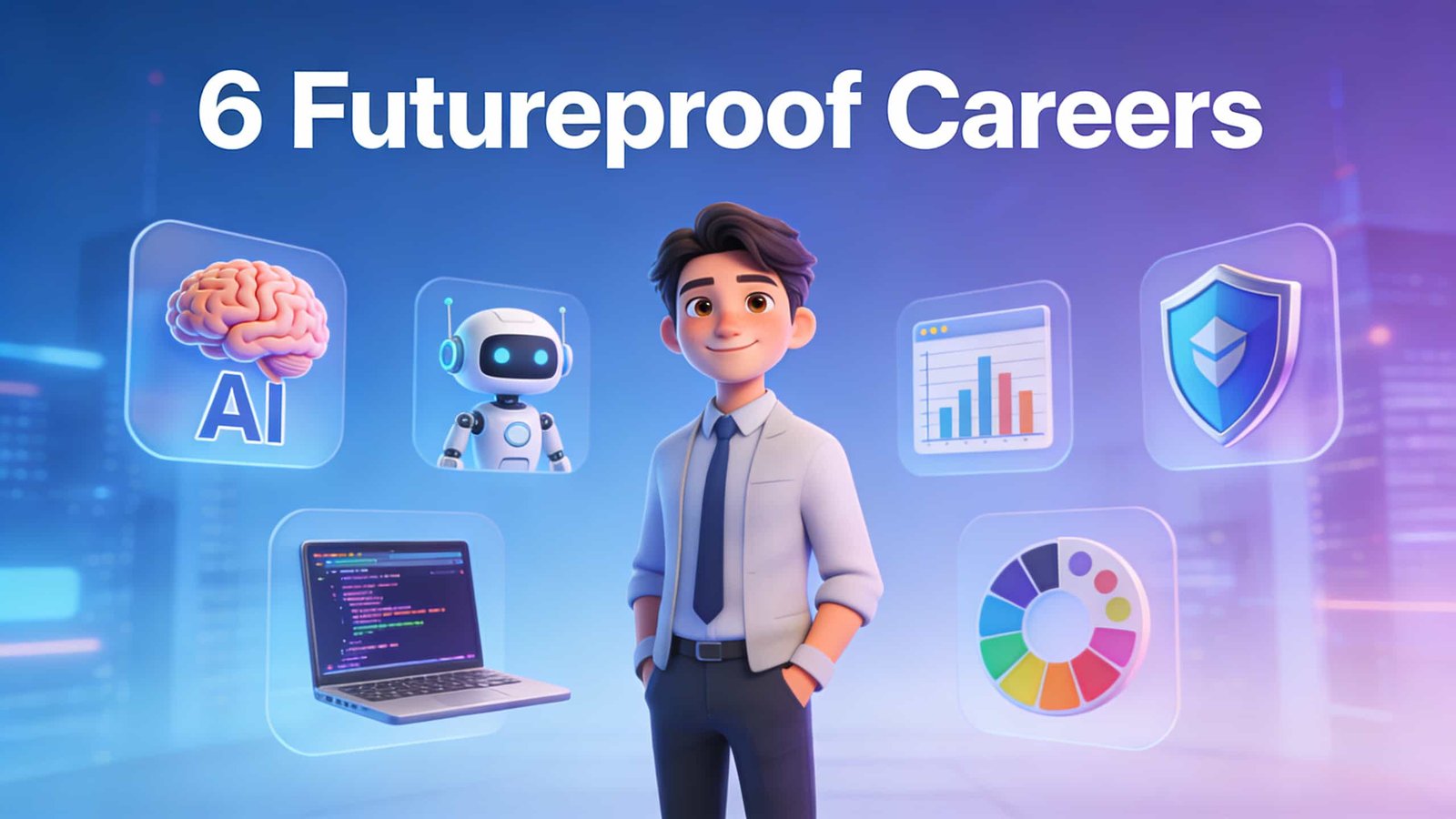
Futureproof Careers for the AI Era
Many people are about to waste years building skills for jobs that will disappear. Whether switching careers or just starting, it’s important to know which direction to go. After analyzing thousands of cutting-edge AI companies and market trends, six highest paying jobs have been outlined that will survive the next decade. These aren’t just trendy jobs everyone’s chasing. They’re the ones that will still pay six figures without having to go to med school or learn rocket science.
Creative Directors
Vision and Intelligence
Starting from the bottom, creative directors. The whole philosophy is being a director over a doer. In the artistic world of AI, understanding the taste, the vision, what are we trying to create here? And getting people to move in a certain direction. That’s valuable. When thinking about the three areas of intelligence analytical intelligence, creative intelligence, and emotional intelligence the director level is one of the most valuable because it challenges people to have a vision for the future that doesn’t exist yet but should. When taste is combined with caring about people, the emotional side, that’s how someone becomes valuable in this world. There are already single-person marketing teams taking over complete agencies. The salary for those kinds of roles is between 100k to 130k per Year.
Learning Curve and Competitive Landscape
Six figures and the learning curve is medium. It’s not that complicated. The competition is also medium. But if a creative role isn’t the right fit, then being a data analyst might be of interest. Essentially, data is used to figure out what’s working, what’s not, and how to guide strategy. The salary is also between 100 and 130k a year. The learning curve is medium. The competition is high because there are already a lot of people entering it.
Data Analyst
Insights and Business Intelligence
But it has stronger potential in regards to being defensible long-term than a creative director because every company is sitting on thousands of terabytes of data. Without data, you’re just another person with an opinion. Bringing the data to back it up is what matters. What data was looked at? Which customer was looked at? Somebody needs to see that inside of the business the data, the reporting, the business intelligence, the analytics. Somebody has to look at the data, the numbers, the text, the information and make sense of it so the business can actually grow. The amount of data is always going up. The amount of information companies capture about their customers and their products is always going up, and somebody needs to be able to look at it.
Extracting Value from Information
Somebody needs to come in and learn how to extract insights from the information. But analyzing data might not pay as much as protecting it. Which brings us to number four from the bottom: cybersecurity specialist. As long as there is digital information, there will be people trying to hack it. There are more people today empowered by AI to steal information than ever before. It’s gotten to the point where a keyword is needed one that only trusted people know so that if somebody calls acting as someone else using their voice, the keyword can be used to verify identity, because AI can literally mimic everybody.
Cybersecurity Specialist
Counteracting AI Threats
There will be a day where somebody joins a video call and tells the team, “Hey, can somebody run down and order a new MacBook Pro and ship it to this address?” And later it turns out no one actually made that request. There needs to be somebody using AI to counteract the bad people using AI to steal. For someone with a protective, bodyguard mentality, this is the perfect role. It involves spending the day protecting digital assets from breaches.
Defensive Mentality and Internal Security
people conducting ransomware attacks where they demand cryptocurrency to unlock computers, or internal threats from people inside the company acting improperly. The salary is between 110 and 140,000 a year. The learning curve is higher, a little more difficult, but the competition is low. Most people gravitate toward creative activities like directing and analysis versus the more difficult work like security. That’s exactly why the competition is low most people are not going to be doing it. One moment of vulnerability can bring the whole business down to zero.
Robotics Engineering
Designing Automated Systems
For those who want to work in the most exciting industry, robotics engineering is worth considering. There is an opportunity to design the machines that will automate the physical world picking up after kids, loading the dishwasher, getting groceries, driving cars. Everybody’s talking about self-driving cars. What about when robots drive the cars? Then every car that isn’t even set up with sensors could be driven because the robots handle it. Go search Optimus Robotics from Tesla. There are literally robotics companies being monitored every week to track what’s coming.
Futureproofing through Robotics
The salary starts at 115 to 150,000 a year. The learning curve is high because a degree may be needed to get into these companies, but the competition is only medium, and that’s why it’s more desirable than the security role. In the future, it will be possible to rent a robot, show it a task once, and it will complete that task over 48 hours. That’s going to happen in the near future.
Full Stack Software Engineer
Scalable Systems and Infrastructure
Robotics engineers combine hardware and software, making the role hard to replace. Most people just focus on AI prompts and automation, but to be truly defensible, understanding both the hardware and the software is key. As labor costs rise, robotics becomes a need, not a nice-to-have. Brett, the CEO of Figure, said it: the future is selling work. But for those not interested in a degree, massive value can still be created as a full stack software engineer.
Infrastructure and Digital Foundations
This is the person that not only knows how code can be written since AI is writing 90% of the code today but understands how to design scalable systems. That’s the part that can’t simply be handed off to an AI tool and trusted to be secure, deployable, and fully functional. Somebody is needed who understands the security infrastructure, the digital foundation of great software and platforms, and who manages that. That’s what a full stack software engineer does. The median salary for that role is 120 to 160k a year, and that’s the minimum today some are making way more.
Business Value and High Leverage
The difficulty is only medium, which is a significant advantage. The competition is higher because a lot of people are being retrained and repositioned in big companies to be full stack engineers. Back in the day, being a specialist made sense. Today, being a director of engineering understanding all the different things that can be built and directing that code is what’s needed. One portfolio company, Revio, had its founder build a whole platform by himself one developer, full stack engineering it not only solving the original problem but solving it for hundreds of other customers.
AI and Machine Learning Specialist
Core Innovation and Specialization
Companies are starting today with a business and a technical person two-person companies building 10 million a year in revenue and they need somebody who can do the full stack engineering. It is one of the highest forms of leverage, and this is why it’s stable for today and into the future. This role creates immediate and massive business value. High-leverage productivity built with the new AI tools is what companies want more than anything. Many businesses are realizing they have a lot of legacy systems that need to be replaced to create a new, simplified experience for their customers that leverages AI, so they can be way more productive with a leaner team.
Building Models and Agentic Systems
But they need the person who understands the full stack. The best way to make sure AI won’t replace a job is to be the one building it, which makes AI and machine learning specialist the number one job on the list. This person understands how to build models that power recommendations. They understand how to diagnose problems and develop autonomous systems essentially agentic systems. Having people with this skill allows scaling at levels no other company in the past has achieved, because they understand AI at the core level. Most people just interact with AI generating images, videos, and text.
Technical Tools and Market Value
If you go on a website called Hugging Face, you will see all the language models, all the different data sets, all the weights, all the inference systems, all the vector database structures, all of the tooling needed to build innovation. That person is going to make a lot of money. The minimum starting salary is 130k six figures minimum but many are making 180k and above. Mastering these tools leads to being highly sought after and highly compensated. The learning curve is high, the difficulty is real, and the competition is low. Zuckerberg paid his top engineers for his new AI team $100 million each18 people. Why? Because these people know how to build the future.
The New Foundation of Innovation
Solving Large-Scale Problems
Mastering this craft and going all in will create value next year, in 10 years, in 50 years. The way to think about it is that normal developers and engineers use AI tools like a chef uses a recipe they just follow it. But AI specialists create entirely new recipes. Looking at the founder of Atlas, one portfolio company, he identified a completely broken system of manual lead follow-up and built an AI platform designed to automate the entire lead follow-up process and every other aspect of customer interaction.
Global Demand and Cognification
He built this because he understood how to use the models. Million-dollar companies are not built off $10 problems. The bigger the problem, the bigger the business. AI is needed to solve those problems because basic logic is no longer enough. Demand is rising in every sector, including the laggards like government, agriculture, and education. They want this. They need innovation. These are the jobs that are driving real product innovation. AI isn’t a trend. It’s literally the new foundation. There’s a great quote by Kevin Kelly: “What can be electrified will be cognified” meaning it will have memory. The person that knows how to write the code for that is going to be in a really great position.
Continuous Learning and Habit Formation
These six jobs will make you incredibly wealthy. Don’t put your head in the sand. Don’t pretend like it’s not happening. Just go learn. Ask AI to teach you. Talk to it. Make it part of your habits. The more that happens, the more competitive you’re going to be in any job. Read More