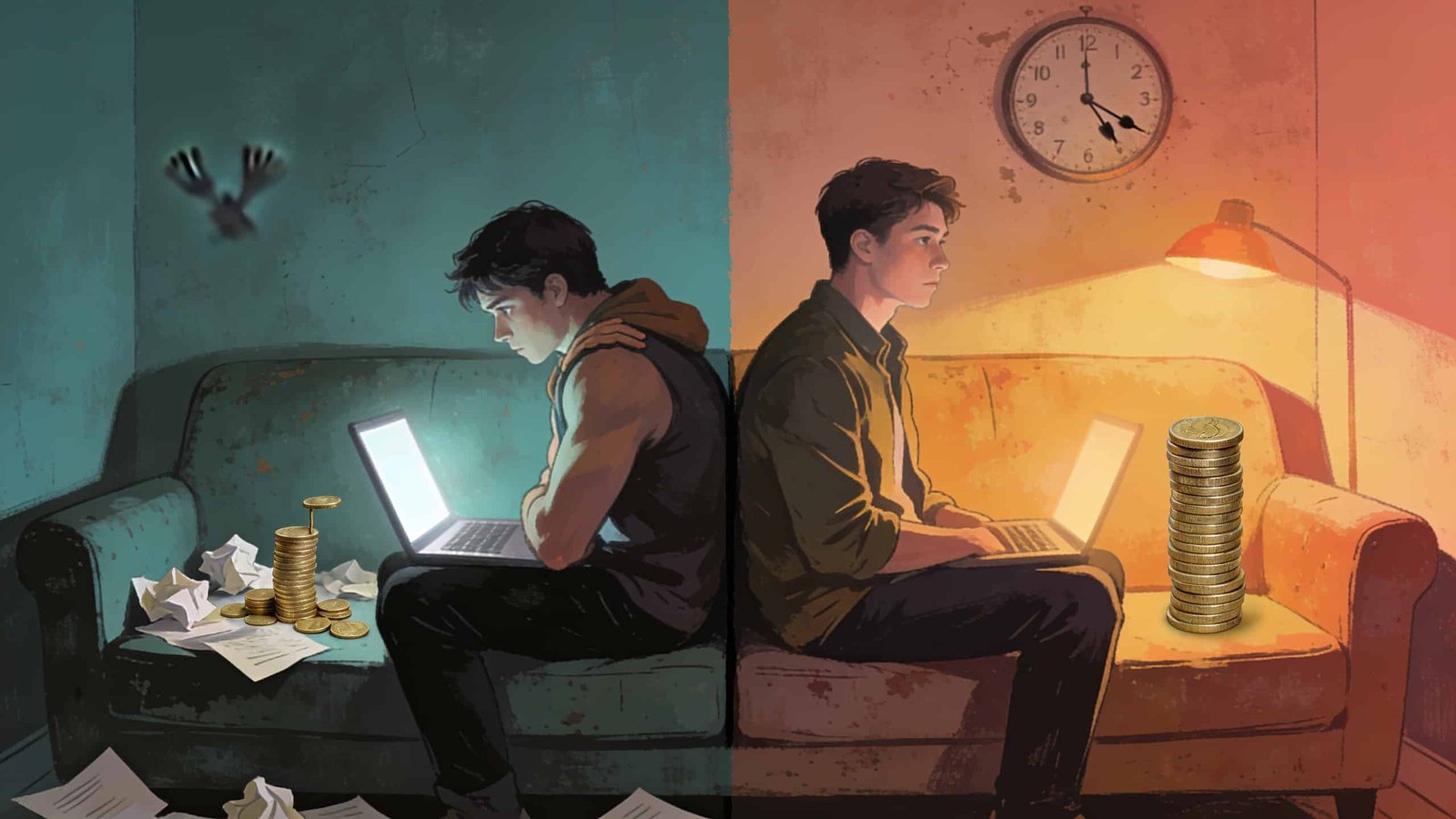
Two years ago, my cousin and I sat on the same old sofa. Both jobless. Both scrolling the same laptop at 1 AM. He picked up freelance writing gigs on Upwork. I took a remote customer support job that paid a fixed monthly salary. Same starting point, same laptop, same slow internet.
Now people keep asking us one thing: which one actually made more money?
Honestly, the answer bothered both of us for a long time. It’s not a simple “this one wins” answer. It depends on things nobody tells you before you start. Let me tell you what actually happened, not the polished version you see in YouTube thumbnails.
The First Few Months Were Hard for Both of Us
My cousin’s first month on Upwork, he made about $40. That’s it. He spent nights writing proposals and bidding on jobs. Clients wanted “5 years experience” for a $10 blog post. He almost quit twice.
My online job paid a fixed $250 a month from day one. Boring, but steady. The money landed in my account every month, whether I worked hard or just did the bare minimum.
So in the first round, the online job clearly paid more. If you’re low on money right now and need something steady, this matters more than any long-term plan.
Then Things Changed Around Month Five
Here’s what nobody warned us about. My online job salary never went up. Same $250, month after month, for over a year. My manager kept saying raises were coming next quarter. They never really came.
My cousin, though, started building a small reputation. Two clients turned into repeat clients. He raised his rate from $5 per article to $25 per article once he had a portfolio to show. By month six, he was making close to $900 a month, and working fewer hours than me.
That’s the part people miss. A steady online job usually pays more in the beginning. But freelancing pays more once you get good and build a few regular clients. It’s slow at first, really slow, but it builds up over time.
What “Online Job” Actually Means Here
I want to be clear because people mix these terms up. When I say online job, I mean things like:
- Remote customer support (call centers, live chat support)
- Virtual assistant roles hired through an agency
- Data entry jobs with a fixed schedule
- Remote jobs found through LinkedIn or Indeed with a real employer
These usually come with a fixed monthly or hourly rate. Sometimes you have a boss. Sometimes someone else sets your deadlines. It’s basically a regular job, just done from your bedroom instead of an office.
Freelancing works differently. You are the business. Platforms like Upwork, Fiverr, and Freelancer.com connect you to clients directly. But you handle everything yourself: pricing, deadlines, client complaints, and taxes.
Real Numbers From 2026
I won’t throw random stats at you that don’t mean anything. Here’s what real income looks like right now, based on people we personally know:
Online jobs (fixed salary, remote):
- Entry-level remote support or VA roles: $200 to $500 a month
- Mid-level remote jobs (project coordinators, junior developers): $600 to $1,500 a month
- Senior remote roles at real companies: $2,000 or more a month, but these jobs are competitive and often need a degree or strong resume
Freelancing:
- Beginners (first 3 months): often $50 to $300 a month, sometimes less
- After building a portfolio (6 to 12 months in): $500 to $2,000 a month is realistic for writing, graphic design, or virtual assistant work
- Skilled freelancers (developers, video editors, specialized designers): $3,000 to $10,000 or more a month, though this is rare and takes years for most people
See the pattern? Freelancing has a much wider range. You could earn less than minimum wage, or more than a full corporate salary. Online jobs are more predictable, but they usually have a ceiling.
The Mistake I Made (Don’t Do This)
I stuck with my fixed-salary online job for way too long because it felt “safe.” I kept telling myself I’d start freelancing once things settled down. Things never settled down. I lost almost a year I could have spent building a freelance profile on the side, testing sites like PeoplePerHour or Upwork just a few hours a week.
My cousin’s mistake was the opposite. He jumped into freelancing full-time with no savings behind him. When Upwork had a slow month (client budgets often dry up in early January and mid-summer), he genuinely struggled to pay his share of the rent.
The lesson from both of us: don’t pick one and completely ignore the other. The smartest people we know do both, at least at first.
Step-by-Step: How to Test Both Without Losing Money
If you’re stuck deciding, here’s what worked for us and a few friends who tried the same thing.
Step 1: Keep your current job or income while you test freelancing. Don’t quit anything yet. Use your evenings or weekends first.
Step 2: Build one solid freelance profile. Pick Upwork or Fiverr, not both at the same time. Spreading yourself across five platforms with an empty profile on each does nothing. Fill your profile out fully, add a real photo, and write proposals that aren’t copy-pasted.
Step 3: Apply to at least 10 small jobs in your first two weeks. Expect rejection. It’s normal. Even good freelancers get ignored a lot at the start.
Step 4: At the same time, apply for 2 or 3 real remote jobs. Try We Work Remotely, Remote.co, or FlexJobs. Stay away from random “make $500 a day” posts on Facebook groups. Most of those are scams or disguised MLM schemes.
Step 5: Give both three months before you judge the results. Neither freelancing nor a remote job shows its real potential in week one. Three months is the minimum to see a real pattern.
Step 6: Compare hours spent, not just money earned. This part matters a lot. Making $300 for 60 hours of freelance work is worse than making $300 for a 20-hour online job. Track your actual hours, not just the money.
Common Mistakes People Make
I’ve seen this happen to at least five people in our small circle:
Jumping into freelancing full-time with no savings cushion. One bad month, and panic sets in fast.
Charging too little on freelance platforms because “I’m new so I’ll charge less.” This actually attracts worse clients who argue over everything. Charging a fair rate from day one, even as a beginner, usually brings in better clients.
Ignoring online job scams. If a “remote job” asks you to pay for training material or a starter kit before you’re even hired, that’s a red flag every time. Check any company you’re unsure about on a site like Glassdoor first.
Comparing freelance income to online job income too early. Freelancing has a slow start. Judging it after two weeks isn’t fair to the process.
Not tracking fees and expenses. Freelancers often forget that platform fees add up. Upwork takes a cut of your earnings, and withdrawal fees through PayPal or Payoneer eat into what looks like a bigger number on paper.
So Which One Actually Pays More in 2026?
If you need money next week and want something steady, an online job wins. Fixed pay, less stress about finding clients, and it’s easier to explain to family who don’t understand “gig work.”
If you can survive a slow first few months and you’re willing to actually build a skill (writing, design, video editing, or anything else), freelancing has a much higher ceiling. My cousin now makes more than double what my online job pays. But it took him almost a year of steady work to get there, and there were months he made less than me too.
There’s also a middle path a lot of people forget about: doing both. Keep a part-time online job for stability, and freelance on the side until it grows enough to replace that income. That’s honestly what worked best for most people I know, including me eventually. I still keep one small steady client from an online job style contract, along with freelance projects that now pay a lot more per hour since I’ve built a track record.
Whichever one you choose, give it real time before you switch. The people who jump between freelancing and online jobs every few weeks, chasing whichever pays more that month, usually end up frustrated with both.